
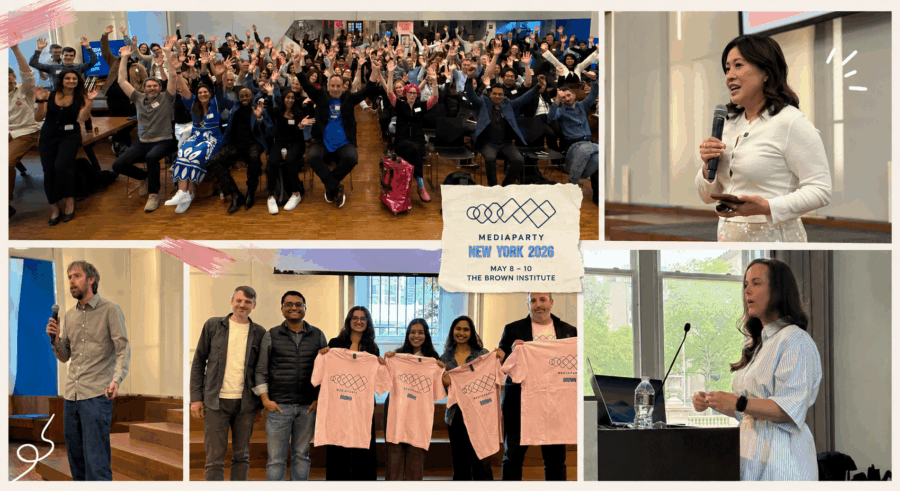
May 8th through 10th were lively at the Brown Institute. Journalists, developers, students, researchers, and media professionals filled Pulitzer Hall, moving between workshops, keynotes, lunches, and lightning talks. It was the second time the Brown Institute hosted Media Party. This year’s New York gathering centered heavily on AI, audience trust, local news, and the rapidly changing ways information is created and distributed.
Media Party is an organization founded in Argentina who go around the world bringing together journalists, technologists and entrepreneurs to rethink the future of media. Mariano Blejman, Nico Russo, Carla Nudel, and Silvina Heguy arrived on campus with high energy and an agenda.
Friday was the opening night. The Brown Institute rimmed with mingling professionals, waiting to hear keynote speakers and lighting talks. Before the speakers took the stage, a Media Fair filled the lobby with projects by organizations like Anfibia, Code for Africa, Daily Maverick, InfoAmazonia, and the Global Index of Responsible AI.
Keynotes quickly began. We heard from Eli Pariser on AI and the future of the information environment. Laura Zommer from Factchequeado gave a moving talk on how AI can connect us to our communities. Hope King (CJS’14) spoke about the rise of the 1-person media company and the “innate entrepreneurial spirit” of journalists. Alexios Mantzarlis from Cornell Tech and Indicator Media gave a talk inspired by Kranzberg’s First Law – “AI is neither good nor bad, nor is it neutral.”
Saturday morning’s keynotes took on a more global perspective, with AI still taking the spotlight. Jacopo Ottaviani from Code for Africa presented Africa Mining Watch, a project using AI and satellite imagery to surface illegal mining. Kathryn Kotze from Daily Maverick showed how her newsroom uses AI “mini-assistants” to cut administrative drag, shrinking grant proposal work from days to hours. Harlan Mandel, CEO of the Media Development Investment Fund made the case that media is not just content, but public infrastructure, as essential to democracy as roads or courts. Joanna Geary from Bloomberg argued that agentic AI is splitting journalism’s audience in two: machines and humans, and those smaller, high-trust human spaces are about to become a newsroom’s most valuable asset.
Saturday afternoon ran three rounds of concurrent workshops. Among many, some highlights: OpenAI’s Christina Lim and Evan Hirsch walked through Codex for newsroom workflows; Logan Williams from Bellingcat ran a satellite imagery session from the basics all the way to AI-assisted analysis; Teresa Mondría Terol demonstrated how local AI models can be used to search through the Epstein files; Mike Reilley covered AI tools that won’t get you fired; Amy Mitchell led a session on the creator economy, and Micah Gelman and Lauren Saks led a hands-on vertical video production workshop.
We closed the weekend on Sunday with a six-hour hackathon. A room full of strangers pitched their projects, formed teams, hacked away at a prototype, and pitched their idea to a jury.
The winner was the Citizen Journalism Network (CJN) – a community-powered platform that uses AI to cluster local reports into real-time “topic bubbles.” It was designed to solve the problem of parachute journalism, where national outlets swoop into local stories without real roots. By surfacing and organizing local sentiment, CJN gives journalists a clearer picture of what actually matters to people on the ground. The team will spend the next three months working with the Brown Institute on mentorship and venture readiness.
Runners-up included SafeSense, a secure document analysis tool for investigative teams, and Wikinews Pulse, a data-driven news portal drawing on Wikipedia and Wikidata.
Media Party’s return to the Brown Institute reflected a broader theme running throughout the weekend: journalism’s future will likely depend not just on new technology, but on collaboration between reporters, technologists, researchers, and local communities. For three days, Pulitzer Hall was where those conversations could happen in real time.