
What this year’s cohort told us about what media needs now
Over the past two weeks, The Brown Institute partnered with StartUp Columbia to host our annual Venture Challenge (Media Track), an opportunity for Columbia students and affiliates to compete for funding to develop projects in the media industry.
Eighteen teams entered, with eight advancing to the final pitch session. Teams presented a three-minute deck of their product idea to a panel of industry experts, followed by a five-minute Q&A. Participants answered questions about their project’s unique value proposition, target audience, revenue model, and the core problem they set out to solve.
What struck us about the cohort wasn’t any single idea. It was the pattern itself. Ideas ranged from immersive spatial experience platform, to a news games consultancy, to a tool improving media literacy for high schoolers. And yes, several projects are AI-supported, leveraging language models, training small local models, exploring how artificial intelligence can generate trust rather than erode it. That’s the part of the story we’d expect given where we are in 2026.
But what was more interesting was the fact that running beneath these pitches was a more fundamental insistence on reliable media and reporting. Getting trustworthy information about elections and candidate platforms into the hands of people who need it. Building culturally rooted narratives for young learners who’ve grown up in media environments that mostly flatten or ignore their cultural roots. There is something refreshing in the projects that advanced to finals and were selected.
Runner-up: Gabble
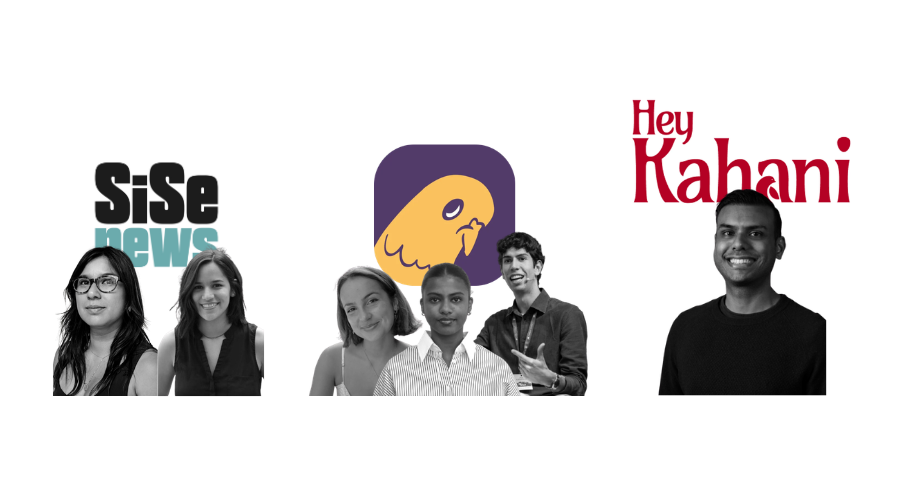
Gabble is an AI-driven interaction platform where humans and artificial intelligence engage in structured, competitive conversations. The team comprises Kit Akinluyi (CC ’25), Taha Mikati (CC ’25), Arhan Soni (Georgetown ’25), and Benny Yang (CC ’25 / GSAAP ’26). Users participate in short, real-time discussion matches against other people or AI agents, with outcomes decided through audience voting and AI adjudication. Every session generates structured data showing how people reason, persuade, and change their beliefs over time.
Third Place ($5,000) – SiSe News
SiSe News is the only social-first, AI-powered, bilingual English/Spanish news curation service in the United States. Conceptualized by Davi Merchan (CJS ’18) and Marina Garcia-Vasquez (CJS ’12), SiSe brings trusted news stories to Latinos regardless of language, removing traditional barriers to access that can keep people from getting the news that they need. They train SLMs to track news in English and Spanish-language publications and generate briefs for their social media anchors to create social-first videos, primarily focusing on digitally-native Gen-Z readers.
Second Place ($10,000) – Palumba
Palumba is a platform that aims to engage and understand the next generation of voters. Ahead of the 2024 European Elections, Pol Villarde (SIPA ‘26) saw a mismatch between the scale of unengaged young voters and the outdated frameworks used to tackle this problem.
Villarde convened a group of young students and professionals sharing this vision, and set out to work. They wrote a blog post explaining how their first year in deployment went. Since then, Palumba reached over 200,000 users on the app store and was deployed in the 2025 German Federal Elections and the New York Mayoral Elections.
They hope to use the funds they won to scale their back-end technology and explore AI implementations that generate trust within users. They plan on scaling the venture across the US starting with the November 2026 Midterms.
First Place ($15,000) – Hey Kahani
Hey Kahani is a screen-free audio storytelling platform for South Asian diaspora children aged three to six. When Hemish Dave (CBS ‘20) was a child, his grandfather would turn on the BBC World Service on the radio in his Nairobi home at 6pm every evening. Dave remembers being transported to stories all over the world. Later, with a walkman and his own cassette tapes, he discovered that he could choose his own stories, without a screen or algorithm deciding what came next.
Dave is a fourth generation Kenyan-Indian, now raising children with his wife in Brooklyn. When his daughter was three, the couple was looking for a story, song, or show that reflected their culture in alignment with their lived reality. Yet they found a flattened narrative of South Asian culture. To combat this problem, Dave built Hey Kahani.
A child picks up a physical story card, taps it to the Kahani Player, and a story begins. The stories are entirely original, produced in-house, and written by interviewing diaspora parents and grandparents across four countries, collecting the specific details of the lived South Asian experience. The school lunch that felt different from everyone else’s, the video call with grandparents on festival mornings, the particular chaos of Onam, Navratri, Diwali or Eid in a house that tries its best to hold onto something it is slowly losing.
The vision for the platform is to become the default platform every South Asian diaspora family turns to when they want their child to grow up knowing where they come from. The team will use their funds to produce more content and extend their community from Brooklyn into the broader NYC metropolitan area, New Jersey and Connecticut, all places with dense South Asian communities.
Witnessing the projects go from proposal to pitch deck was deeply fulfilling for us. We’re incredibly grateful to our participants for their proposals and pitches, and our panel of judges for their time, expertise, and thoughtful feedback.
We can’t wait to see where these ideas go next.